What Is Play Therapy? What Houston Parents Can Expect (and What Play Therapy Is Not)
Understanding how play therapy helps children express emotions, develop coping skills, and work through challenges
If you've ever asked your child what's wrong and received a shrug, an "I don't know," or an unexpected meltdown, you're certainly not alone. Children often experience big emotions long before they have the language or emotional awareness to explain what they're feeling.
As parents, we want to help our children navigate anxiety, frustration, sadness, behavioral challenges, and difficult life experiences. But sometimes, traditional conversations simply aren't enough.
That's where play therapy comes in.
At Heights Family Counseling in Houston, TX, we understand that children communicate differently than adults. While adults often process their experiences through conversation, children frequently express themselves through play.
Play therapy meets children where they are developmentally, using their natural way of communicating to help them understand emotions, build coping skills, and develop healthier ways of navigating their world.
But what actually happens during play therapy? Is your child just playing with toys? Will the therapist tell you what your child says? And how do you know whether it's working?
Let's explore what Houston parents can expect.
What Is Play Therapy?
Play therapy is a therapeutic approach that uses play as a way for children to communicate, process experiences, and work through emotional and behavioral challenges.
Unlike traditional talk therapy, which relies heavily on verbal communication, play therapy allows children to express thoughts and feelings through activities that feel comfortable and natural to them.
A child may not be able to say, "I'm feeling anxious because my parents have been arguing," but those feelings might emerge through storytelling, pretend play, or interactions with toys and figures.
A trained play therapist understands how to use these interactions to support a child's emotional development.
Play therapy may involve:
Pretend play with dolls, animals, or figurines
Art, drawing, and creative expression
Sand tray activities
Therapeutic games
Role playing
Storytelling
Activities that support emotional identification and regulation
The specific activities depend on the child's age, developmental needs, personality, and treatment goals.
The important distinction is that play therapy isn't simply playing. It's therapy that uses play as the primary method of communication and healing.
What Does a Play Therapy Session Actually Look Like?
One of the most common questions parents ask is, "What will my child actually do during their appointment?"
The answer depends on your child's needs and the therapeutic approach being used, but here's a general idea of what to expect.
1. The Initial Parent Consultation
Play therapy often begins with a conversation between the parents or caregivers and the therapist.
During this appointment, the therapist will want to understand your child's developmental history, personality, strengths, and current challenges.
You might discuss concerns such as:
Frequent meltdowns or emotional outbursts
Anxiety, excessive worry, or separation difficulties
Behavioral challenges at home or school
Difficulty making or maintaining friendships
Changes in family relationships
Divorce, grief, or other major life transitions
ADHD, impulsivity, or difficulty regulating emotions
This is also an opportunity for parents to share what they've tried, what seems to help, and what they hope will change.
You don't need to have everything figured out before seeking help. Part of the therapist's role is to work with you to better understand what may be contributing to your child's difficulties.
2. Getting Comfortable in the Playroom
For many children, the first few sessions are about building trust.
Your child's therapist will introduce them to the playroom and help them feel comfortable in the environment.
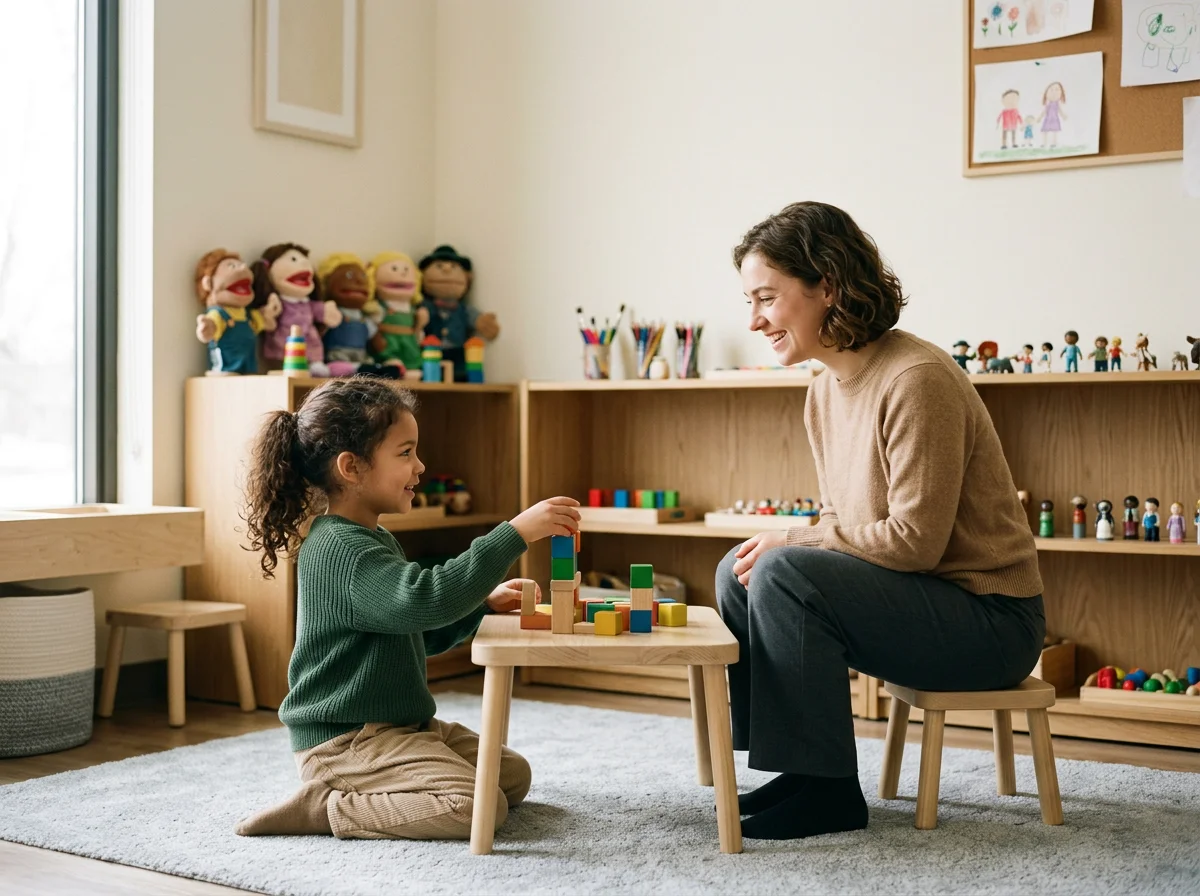
A play therapy room may include toys, dolls, games, art supplies, a sand tray, and other materials chosen specifically for therapeutic purposes.
Some children jump right into playing. Others are hesitant, quiet, or unsure what to do.
All of these responses are completely normal.
The therapist isn't expecting your child to immediately open up or discuss difficult feelings. Instead, they focus on developing a safe, trusting relationship where your child feels accepted and understood.
3. The Therapeutic Play Process
Once your child feels more comfortable, the therapist uses play to help them explore emotions, practice new skills, and work through challenges.
For example, a child struggling with anxiety might repeatedly create stories about characters who are afraid or need protection.
A child having difficulty with emotional regulation might become frustrated when a game doesn't go their way.
A child experiencing family changes might use dolls or figures to explore relationships and feelings of uncertainty.
These moments create opportunities for the therapist to help children identify emotions, develop coping strategies, experience a sense of control, and practice healthier responses.
Sometimes the therapist follows the child's lead. Other times, they introduce structured activities to target specific therapeutic goals.
Even when a session looks like ordinary play, the therapist is intentionally using the interaction to support your child's emotional and behavioral growth.
It's also important to remember that not every toy choice or pretend play scenario has a hidden psychological meaning. Therapists consider patterns, developmental context, and the child's overall functioning rather than interpreting individual play behaviors in isolation.
What Play Therapy Is NOT
Understanding what play therapy isn't can be just as helpful as understanding what it is.
Play Therapy Is Not Just Playing With Toys
This is probably the biggest misconception.
Yes, your child will likely play during sessions. They may even tell you they had fun!
But enjoyment doesn't mean therapy isn't happening.
A trained play therapist uses a thoughtful, developmentally appropriate therapeutic process to help children work toward specific emotional and behavioral goals.
Just as adults may benefit from talking through their experiences, children can benefit from processing emotions through play.
Play Therapy Is Not a Place Where Children Are Forced to Talk
Some parents worry that their child won't participate because they are shy or have difficulty discussing feelings.
Fortunately, play therapy doesn't require children to sit in a chair and answer questions about their emotions.
In fact, many children who struggle with traditional conversations respond well to play therapy precisely because it removes that pressure.
The therapist allows communication and emotional expression to develop naturally.
Play Therapy Is Not a Discipline Program
Play therapy isn't about teaching children to obey adults or eliminating every unwanted behavior.
While improved behavior may be an important treatment goal, the therapist also works to understand the emotions, developmental needs, and experiences that may be contributing to those behaviors.
For example, a child who frequently becomes angry may actually be experiencing anxiety, frustration, or difficulty communicating their needs.
Addressing the underlying challenge can help create more meaningful, lasting change.
Play Therapy Is Not About Blaming Parents
Parents sometimes worry that bringing their child to therapy means they've done something wrong.
That isn't the purpose of play therapy.
Children experience emotional and behavioral challenges for many reasons, including temperament, developmental differences, stress, family transitions, and environmental demands.
The goal is to understand your child and strengthen the support available to them.
Parents are important partners in that process.
Play Therapy Is Not an Overnight Fix
Just like adult therapy, play therapy takes time.
Children need an opportunity to establish trust, practice new skills, and gradually develop healthier ways of managing difficult experiences.
Some families notice improvements fairly quickly, while others need a longer period of treatment.
Progress is rarely perfectly linear. Children may have wonderful weeks followed by difficult days.
That doesn't necessarily mean therapy isn't working.
Will My Child's Play Therapist Tell Me What Happens During Sessions?
This is an important question, and one we encourage parents to ask.
At Heights Family Counseling, we believe that parents and caregivers play an essential role in supporting children's emotional health.
However, children also benefit from having a therapeutic space where they feel safe expressing themselves.
Your child's therapist will work to balance confidentiality with appropriate parental involvement.
Rather than providing a detailed account of every interaction, the therapist may share broader themes, treatment goals, developing skills, and recommendations for home.
For example, you might learn that your child is working on frustration tolerance, identifying anxiety triggers, or expressing anger more appropriately.
You'll also have opportunities to share what you're noticing outside of therapy.
The specific boundaries of confidentiality will be discussed with you, including situations involving safety concerns that require additional communication.
Will Parents Participate in Play Therapy?
Often, yes!
Although the child may spend much of their appointment individually with the therapist, parent involvement can be an important part of treatment.
Your child's therapist may recommend periodic parent consultations, family sessions, or strategies to practice at home.
These conversations can help parents better understand their child's emotional needs and develop more effective ways to respond to difficult behaviors.
For example, parents may learn ways to support emotional regulation, respond to anxiety, establish healthy boundaries, or improve communication.
Our philosophy at Heights Family Counseling is that supporting the child often means supporting the entire family.
We recognize that emotional growth doesn't happen only inside the therapy room. It happens in everyday moments at home, at school, and within relationships.
What Issues Can Play Therapy Help With?
Play therapy can be helpful for children navigating a variety of emotional, behavioral, and developmental challenges.
Common reasons Houston families seek play therapy include:
Anxiety: Excessive worry, fears, separation anxiety, and avoidance
Emotional regulation: Frequent meltdowns, frustration, anger, and difficulty calming down
ADHD: Impulsivity, frustration tolerance, emotional awareness, and social challenges
Family transitions: Divorce, relocation, a new sibling, or changes in family relationships
Grief and loss: Processing death, separation, or significant changes
Social difficulties: Friendship challenges, conflict, and difficulty navigating relationships
Trauma and stressful experiences: Helping children process difficult events in a developmentally appropriate way
Self esteem: Developing confidence, emotional awareness, and resilience
Not every child experiencing these challenges will need play therapy, and not every therapeutic approach is appropriate for every child.
A child therapist can help determine whether play therapy, cognitive behavioral therapy, parent focused interventions, family therapy, or a combination of approaches would be most helpful.
How Long Does Play Therapy Take to Work?
There isn't a universal timeline for play therapy.
Treatment length depends on several factors, including your child's age, the nature of their difficulties, the length of time symptoms have been present, and the goals established with your therapist.
Some children benefit from relatively brief treatment focused on a specific challenge. Others may need more ongoing support.
In many cases, sessions are scheduled weekly, particularly during the early stages of treatment.
Your therapist should regularly evaluate progress and collaborate with you about whether treatment goals are being met.
How Will I Know If Play Therapy Is Helping?
Progress doesn't always look like a child suddenly becoming happy, compliant, or free from emotional challenges.
Instead, you might notice gradual changes such as:
Your child recovering more quickly after becoming upset
Fewer or less intense emotional outbursts
Increased ability to identify and express feelings
Greater confidence in unfamiliar situations
Improved communication with family members
More flexibility when things don't go as planned
Stronger coping skills during stressful moments
Improved relationships with peers or family members
Sometimes the first sign of progress is simply that your child feels more comfortable talking about or expressing difficult emotions.
Your therapist can help identify measurable goals and evaluate meaningful changes over time.
How Do I Explain Play Therapy to My Child?
Parents often wonder what to say before their child's first appointment.
We generally recommend keeping the explanation simple, positive, and appropriate for your child's age.
You might say:
"Sometimes kids have big feelings that are hard to understand. We're going to meet someone whose job is to help kids with those feelings. They have toys and activities you can use together, and you don't have to know exactly what to say."
Try to avoid describing therapy as something your child must attend because of bad behavior.
Instead, frame it as a supportive place where children can better understand themselves and learn helpful skills.
And remember, it's perfectly okay if your child feels nervous at first.
Finding Play Therapy in Houston, TX
Choosing a therapist for your child is an important decision.
When searching for play therapy in Houston, look for a licensed mental health professional with specialized training and experience in child development and play based therapeutic approaches.
You may also want to ask about the therapist's experience with your child's specific concerns, how parents are involved, and how treatment goals and progress are evaluated.
The relationship between your child and their therapist is especially important. Children are more likely to engage in the therapeutic process when they feel safe, respected, and understood.
Play Therapy at Heights Family Counseling in Houston
At Heights Family Counseling, we believe children deserve a space where they can feel understood, accepted, and supported as they navigate the challenges of growing up.
Our child therapists recognize that every child is different, which is why we tailor treatment to each child's unique developmental needs, personality, and family circumstances.
We use developmentally appropriate, evidence based approaches, including play therapy, sand tray therapy, cognitive behavioral techniques, and family involvement when appropriate.
Our goal isn't simply to reduce difficult behaviors. We want to help children develop emotional awareness, stronger relationships, healthy coping skills, and confidence that will support them as they grow.
We also recognize that parents know their children better than anyone, and we value collaborating with families throughout the therapeutic process.
Interested in Play Therapy in Houston?
If your child is struggling with anxiety, emotional outbursts, behavioral challenges, or difficult life transitions, play therapy may be a helpful place to begin.
You don't have to wait until your child's challenges become overwhelming to seek support.
At Heights Family Counseling, we're here to help you better understand your child's needs and explore the support that may be right for your family.
Heights Family Counseling
611 W. 22nd Street, Suite 100
Houston, TX 77008
Learn more about our child counseling services or contact our Houston office to get started.
Because sometimes the most meaningful conversations children have happen without words.